
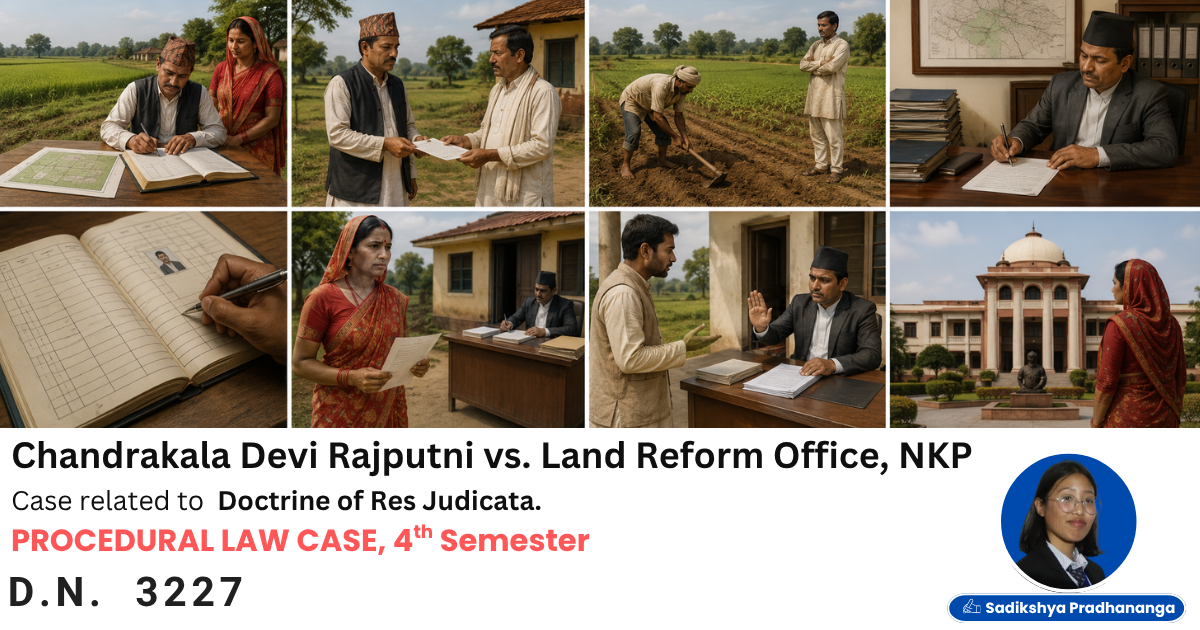
Procedural Law Case: Chandrakala Devi Rajputni vs. Land Reform Office, NKP 2044 B.S., No. 10, DN: 3227
Case: Property/Land Reform
Plaintiff: Chandra Kala Devi Rajputni
Defendants: Land Reform Office
Decision Number: 3227
This case is concerned with the application of the doctrine of Res Judicata (प्राङन्याय) under Muluki Ain, Chapter on Court Procedure (अ.बं.) No. 85.
Facts of the Case:
The disputed land in Rautahat was originally registered in the name of the petitioner’s husband, Jug Prasad Singh. In 2014 B.S., he had mortgaged the land through a possessory mortgage to Rajdhari Singh. During the mortgage period, the mortgagee allowed respondent Anup Mahato Kahar to cultivate the land. After the implementation of the Lands Act, the mortgage arrangement was settled through a decision of the Land Reform Office on 2043/11/04, and the petitioner claimed that the land had thereafter remained under her control. However, Anup Mahato had obtained registration as a tenant (Mohi) of the land. Believing that such tenancy registration was unlawful because Anup Mahato had merely cultivated the land on behalf of the mortgagee and not as a lawful tenant, Chandrakala Devi filed an application before the Land Reform Office seeking cancellation of the Mohi record.
Before her application, her deceased husband’s nephew, Mahendra Prasad Singh, had filed a similar complaint regarding the same land. That complaint had been dismissed on 2040/11/01. Relying on that earlier dismissal, the Land Reform Office held that the matter had already been decided and dismissed Chandrakala Devi’s claim under No. 85 of the Muluki Ain based on res judicata. Chandrakala Devi then filed a writ petition before the Supreme Court, arguing that the nephew had no legal ownership or interest in the land and therefore his earlier complaint could not prevent the true right-holder from seeking legal relief.
Legal Issues:
- Whether the doctrine of Res Judicata (प्राङन्याय) under A.B. No. 85 applies when the previous case was filed by a person who had no legal right over the disputed property.
- Whether dismissal of a claim filed by an unauthorized person extinguishes the legal right of the actual right-holder to bring a claim.
- Whether the Land Reform Office correctly dismissed the petitioner’s application under A.B. No. 85.
Different Courts’ Decisions:
Supreme Court:
The Supreme Court held that:
For Res Judicata to apply, the earlier case must have been filed by a person possessing a legal right or interest in the subject matter. Here, the earlier case had been filed by Mahendra Prasad Singh, the nephew of the deceased owner, who had no legal right over the disputed land. Therefore, the dismissal of that case could not prevent the actual right-holder (the widow, Chandrakala Devi) from filing her own claim.
The court observed that the Land Reform Office wrongly applied A.B. No. 85; that’s why the decision of the Land Reform Office dated 2042/05/25 was quashed through Certiorari, and an order of Mandamus was issued directing reconsideration according to law.
Principle Established:
-
- Doctrine of Res Judicata to be applied under A.B. No. 85, the previous case must have been filed and decided between persons who possess a legal right or interest in the matter.
- A decision obtained in a case filed by a person having no legal right over the property cannot bar the true right-holder from filing a subsequent claim.
- The legal rights of the actual right-holder cannot cease if an unauthorized person unsuccessfully litigated the matter.
- Procedural rules such as Res Judicata should not be used to deprive a lawful claimant of the opportunity to assert their substantive legal rights.
Final Holding:
Supreme Court held that the Land Reform Office wrongly applied Muluki Ain, A.B. No. 85 because the earlier case had been filed by a person who lacked legal entitlement over the disputed land. Therefore, the doctrine of Res Judicata couldn’t be applied. The disputed decision was quashed, and the Land Reform Office was directed to decide the tenancy cancellation dispute afresh according to law.
*Note: Res judicata is a Latin legal term meaning “a matter judged”. It is a fundamental doctrine that prevents parties from re-litigating a claim or issue that has already been conclusively decided by a competent court.