
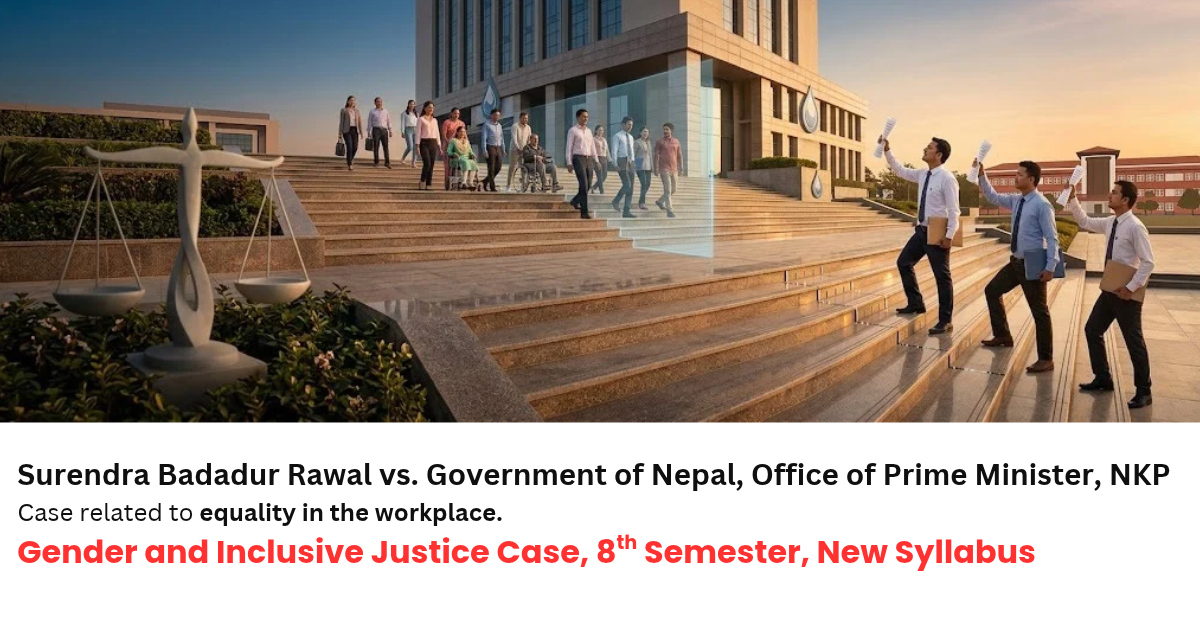
Gender and Inclusive Justice Case: Surendra Badadur Rawal vs. Government of Nepal, Office of Prime Minister, NKP 2080 B.S, No.11 DN: 11199
Case: Certiorari
Plaintiff: Surendra Badadur Rawal
Defendant: Government of Nepal, Office of Prime Minister
Decision Number: 11199
This case relates to special measures in promotion, equality at the workplace, and the use of inclusion policies for employees from disadvantaged groups.
Facts of the Case:
The petitioners were engineers working at Kathmandu Upatyaka Khanepani Limited. They had been appointed through open competition and were working in the Civil Engineering group at the seventh level.
In 2019, the company amended its Employee Administration Regulations. The amendment added a provision concerning the minimum service period required for promotion. It allowed women, Indigenous Nationalities, Madhesi, Dalit and disabled employees, and employees permanently residing in backward regions to become eligible for promotion even if they had completed one year less than the normal service period.
The normal minimum service period was three years for assistant level posts and four years for officer level posts. The amendment did not automatically promote eligible employees. It only allowed them to apply and compete for promotion after completing one year less than the normal period.
On 1 August 2021, the company published a promotion notice for various posts, including engineering posts. The petitioners challenged the amended provision and the promotion notice before the Supreme Court.
Petitioners’ Claim:
The petitioners argued that they had already entered service through open competition. They said that giving another special benefit at the promotion stage created unequal treatment and harmed their promotion opportunities, seniority and career development. They asked the Court to cancel the amended provision and the promotion notice.
Government and Company’s Argument:
The company argued that the amendment only reduced the minimum period for becoming eligible to apply for promotion. It did not guarantee promotion. Promotion still depended on performance, seniority, education and training.
The company also argued that the provision followed the Constitution and the Civil Service Act. It said that the special measure was intended to support employees from socially, geographically and historically disadvantaged groups.
Legal Issues:
- Whether giving certain disadvantaged groups a one year relaxation in the minimum service period for promotion violated the right to equality?
- Whether a special inclusion measure could be used at the promotion stage?
- Whether the amended regulation harmed the petitioners’ employment and promotion rights?
- Whether the promotion notice based on the amended regulation was unlawful?
Decision of the different courts:
Supreme Court:
Supreme Court dismissed the petition, holding that the amended provision did not violate the rights to equality or employment.
The Court clarified that the amendment only allowed certain employees to become eligible for promotion one year earlier. It did not guarantee promotion or lower the required standards. Promotion still depended on performance, seniority, education and training.
The Court further held that special measures for disadvantaged groups do not amount to discrimination. They are temporary measures intended to achieve substantive equality by addressing social, geographical and historical disadvantages.
The Court also clarified that such measures are not meant to provide permanent or repeated advantages, but to ensure fair opportunities until disadvantaged groups achieve meaningful participation. Since the amendment was made in consultation with the Public Service Commission and was consistent with the constitutional policy of inclusion, there was no reason to invalidate it. The writ petition was therefore dismissed.
Principle Established:
1. Equality does not always mean treating everyone equally. Special measures may be introduced for disadvantaged groups to ensure equal opportunities. Therefore, temporary relaxation of the promotion eligibility period does not automatically amount to discrimination.
2. Such relaxation only allows employees to compete for promotion; it does not guarantee promotion. Factors like performance, seniority, education and training may still determine the final selection.