
Gender and Inclusive Justice Case: Narayanlal Manandhar vs. Shakti Kumar Basnet, NKP 2077 B.S No. 9, DN: 10573
Case: Partition of Property
Plaintiff: Narayanlal Manandhar
Defendant: Shakti Kumar Basnet
Decision Number: 10573
This case is related to the right of a child to inherit family property, proof of parentage, and the evidentiary value of DNA testing and official documents.
Facts of the Case:
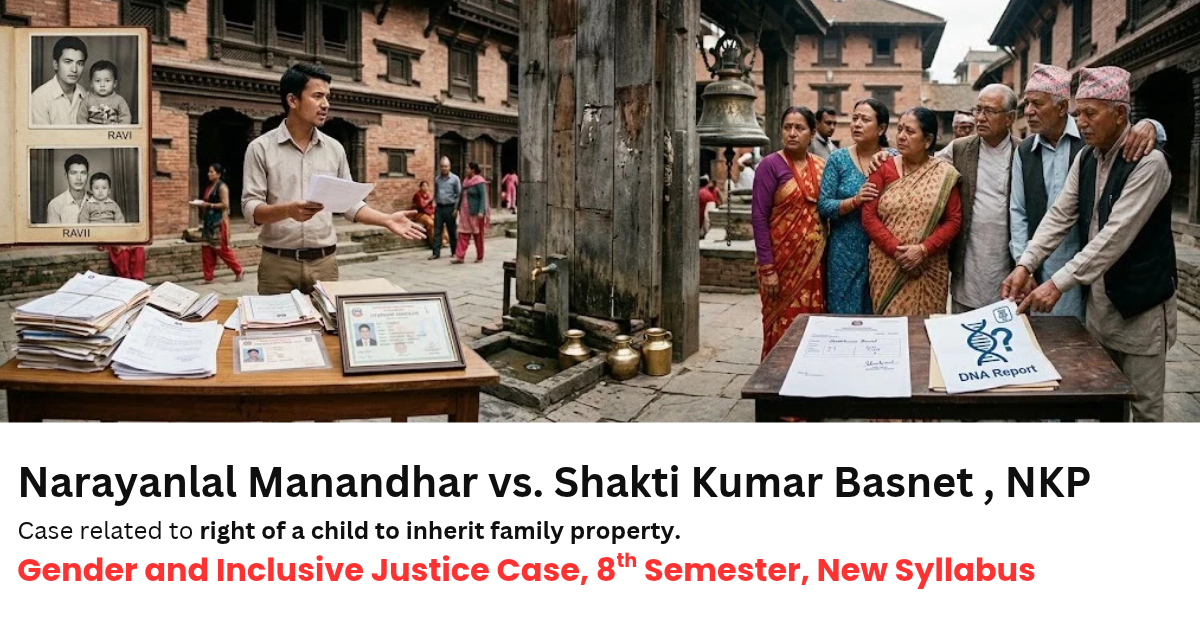
Shakti Manandhar claimed to be the son of Ravi Manandhar, who was the middle son of Ishwor Manandhar. Ravi had lived separately with his wife, Rajyudevi Basnet, and their son, Shakti. After Rajyudevi’s death, Ravi raised Shakti, supported his education and lived with him until his own death.
After Ravi’s death, Shakti claimed his share of the undivided family property. However, Ravi’s brothers and sisters denied that he was Ravi’s son.
The defendants relied on his mother’s pension record, which listed him as Shaktikumar Basnet, and a DNA test that did not establish the same paternal family line. In response, Shakti presented his citizenship certificate, school records, voter records and relationship certificate identifying Ravi as his father.
The main dispute was whether the DNA report and use of his mother’s surname were sufficient to reject the other evidence of his parentage.
Plaintiff’s Claim:
Shakti said that Ravi was his father and that he was the only person entitled to inherit Ravi’s share. He relied on his citizenship certificate, school records, voter records, relationship certificate and other documents. He also stated that Ravi had accepted him, raised him and supported his education. He asked for one-fifth of the family property.
Defendants’ Argument:
The defendants said that Ravi had never married and had no son. They claimed that they had never known Shakti as Ravi’s child. They relied on the DNA report and on the mother’s pension record, where Shakti’s name appeared as “Shaktikumar Basnet,” using his mother’s surname. They argued that Shakti was not their heir and should not receive any property.
Legal Issues:
- Whether Shakti was the son of Ravi Manandhar?
- Whether using his mother’s surname disproved his relationship with Ravi?
- Whether the DNA report alone was enough to decide the issue of parentage?
- Whether Shakti was entitled to a share of the family property?
Decisions of the Different Courts:
Kathmandu District Court:
The District Court mainly relied on the DNA report. It held that Shakti’s relationship with Ravi was not proved. The Court dismissed his claim for partition. There was no criminal punishment because this was a civil property case.
Patan Appellate Court:
The Appellate Court reversed the District Court’s decision. It accepted the official documents and other evidence showing that Ravi was Shakti’s father. It held that Shakti was an heir and awarded him one fifth of the family property.
Supreme Court:
The Supreme Court upheld the Appellate Court’s decision. The Court noted that Ravi had accepted Shakti as his son during his lifetime. He had raised him, paid for his education and lived with him. Official records also named Ravi as Shakti’s father.
The Court held that using the mother’s surname, “Basnet,” did not disprove Shakti’s relationship with his father. A woman may use her own surname, and a child may use the surname of the father, mother or both.
The Court also held that a DNA report is important expert evidence, but it is not always conclusive. It must be considered together with other reliable evidence. The District Court had made an error by relying only on the DNA report and ignoring the other evidence.
The Supreme Court confirmed Shakti’s right to receive one-fifth of the family property. The defendants’ appeal was dismissed.
Principle Established:
1. A DNA report is not always conclusive proof of parentage and must be considered along with other evidence.
2. Using the mother’s surname does not disprove the relationship with the father. Official records and the father’s conduct may also establish parentage.
3. A child accepted and raised by the father should not be denied inheritance solely on the basis of a later DNA report.