

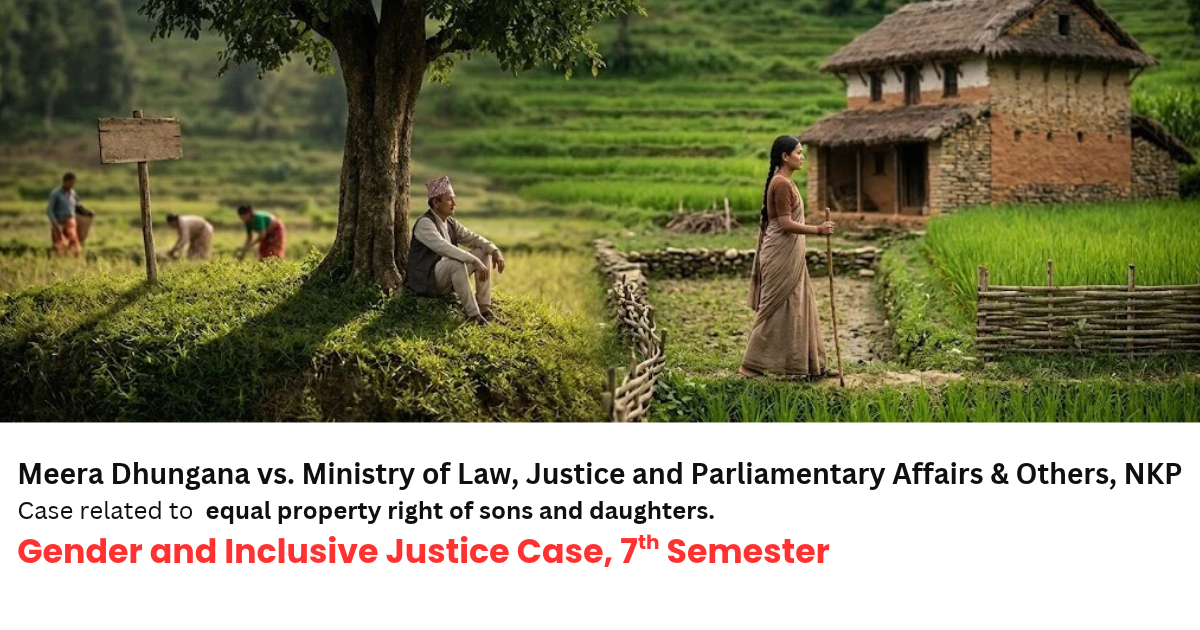
Gender and Inclusive Justice Case: Meera Dhungana vs. Ministry of Law, Justice and Parliamentary Affairs & Others, NKP (2057), No. 6, P. 462, DN: 6013
Case: Relating to void of Unconstitutional law
Plaintiff: Meera Dhungana et.al
Defendant: Ministry of Law, Justice and Parliamentary Affairs & Others
Decision Number: 6013
The case is relating to equal property rights of sons and daughters and discrimination against daughters in parental property under the Muluki Ain, 2020.
Facts of the Case:
Meera Kumari Dhungana and Meera Khanal challenged Section 16 of the Partition Chapter of the Muluki Ain, 2020, which imposed unequal conditions on daughters’ inheritance rights.
Under the provision, an unmarried daughter could claim parental property only after reaching 35 years of age and subject to certain conditions. If she later married, she was required to return the property.
In contrast, sons could generally claim their share of parental property without such age or marital conditions.
The petitioners also challenged other provisions of the Partition Chapter that gave sons a direct inheritance right while placing additional restrictions on daughters.
They argued that these provisions violated the right to equality under Article 11 of the Constitution of the Kingdom of Nepal, 1990, and the principles of gender equality under CEDAW.
Plaintiff’s Claims:
The petitioners claimed that the law discriminated against daughters because a son could obtain a share in parental property without an age restriction, while an unmarried daughter had to wait until 35 and satisfy additional conditions. They argued that the discriminatory provisions should be declared invalid and that daughters should have property rights equal to those of sons.
Defendants’ Arguments:
The Government argued that daughters were not completely denied property rights, as unmarried daughters could inherit after meeting legal conditions, while married daughters could obtain property from their husband’s family.
It further argued that equal inheritance rights could allow married daughters to receive property from both families and that the interconnected property system should not be changed by removing a single provision.
Legal Questions:
- Whether Section 16 of the Partition Chapter violated the constitutional right to equality?
- Whether requiring an unmarried daughter to reach 35 before receiving parental property was discriminatory?
- Whether the provisions giving sons a different position in inheritance were unconstitutional?
- Whether the Court could direct the Government to reform the wider property and inheritance system?
Different Court Decisions:
Supreme Court:
The Special Bench did not declare Section 16 invalid. The Court held that the provision did not completely deprive daughters of property rights but regulated those rights differently according to their marital status within the existing family property system.
The Court considered that a married daughter could obtain property through her husband’s family, while an unmarried daughter could claim property from her father after satisfying the conditions prescribed by law. It also considered the Government’s concern that giving a married daughter an immediate right to parental property in the same manner as a son could allow her to claim property from both families.
However, the Court recognised the need for a broader examination of the property and inheritance laws. Rather than striking down one provision in isolation, it directed the Government to study the issue more comprehensively.
The Government was directed to consult women’s organizations, sociologists, social organizations and lawyers, examine relevant laws of other countries, and prepare a suitable bill for broader legal reform within one year.
The petition to invalidate Section 16 was therefore not granted, but a directive for wider legal reform was issued.
Principles Established:
1. Equality requires fair treatment and protection against gender based discrimination.
2. Property and inheritance laws must be examined as a whole to avoid further legal inequality.
3. Traditional family structures cannot justify unequal property rights between men and women.
4. Laws that discriminate based on gender must be reviewed and reformed.
5. Constitutional equality must guide legislative reforms to ensure equal rights.