
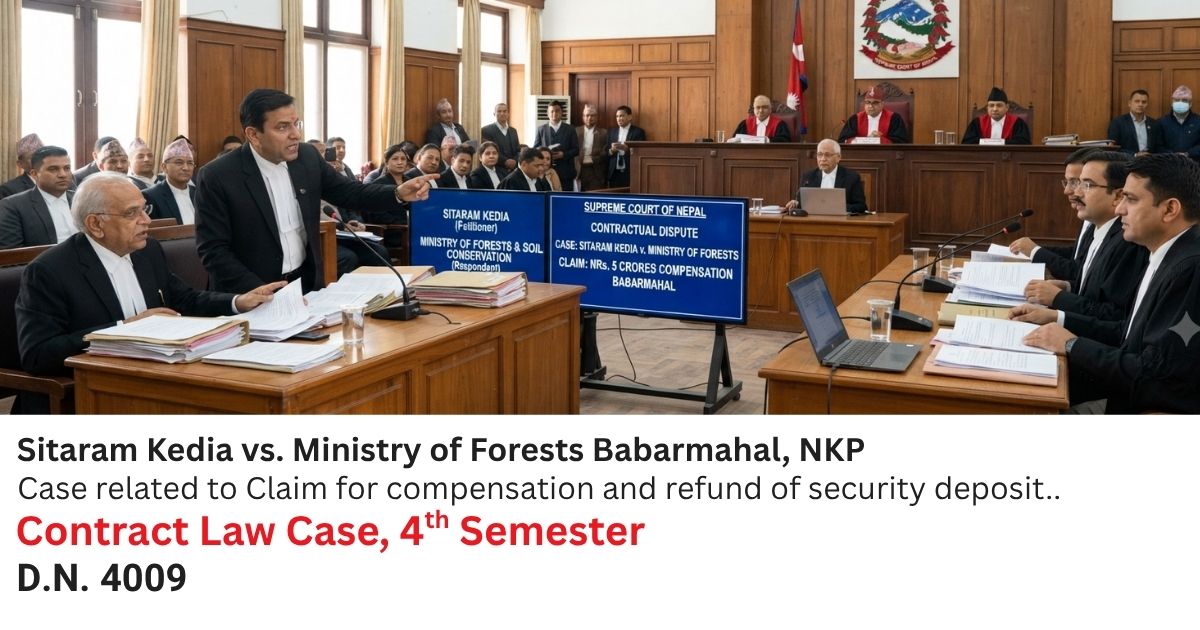
Contract Law Case: Sitaram Kedia vs. Ministry of Forests Babarmahal, NKP, 2046, No.11, P1183.
Case: Breach of contract
Plaintiff: Pradip Kumar Kedia
Defendant: Ministry of Forests, Kathmandu, and other concerned government forestry authorities.
Decision No: 4009
This case is related to breach of contract cancellation of a timber-sale contract, forfeiture of security deposit, and compensation for loss.
Facts of the Case:
On 18 Chaitra 2034 B.S., Kedia Hanuman Rice & Saw Mill entered into a contract with the Government of Nepal to purchase and cut 8,522 marked trees from four forest plots numbered 3, 4, 5, and 6 in Vijayabasti, under the Rapti Dun Forest Division. The contract required the purchaser to cut and transport the timber to the designated depot by the end of Ashadh 2035 B.S. and pay for and remove the timber deposited there by the end of Jestha 2036 B.S. The purchaser deposited Rs. 80,000/- as security. Due to the rainy season and difficulties involving roads and rivers, the purchaser claimed that it could not complete the cutting and transportation within the original period. It requested an extension of time. On 17 Ashwin 2035 B.S., the government cancelled the contract because less than 60% of the required work had been completed and ordered the forfeiture of the security deposit and the timber. The purchaser claimed Rs. 5,00,000/- in damages and the return of the Rs. 80,000/- deposit, totalling Rs. 5,80,000/- The lower courts rejected the claim, leading to an appeal before the Supreme Court.
Plaintiff’s Claim:
Plaintiff argued that it had entered into the contract in good faith and had already performed part of the required work. The rainy season and difficult transportation conditions prevented timely completion, and it had requested an extension. Since the period for paying for and removing timber already deposited at the depot extended until Jestha 2036 B.S., the government should not have cancelled the contract and confiscated the security deposit before that period expired. Plaintiff sought Rs. 5,00,000/- as compensation and the return of the Rs. 80,000/- security deposit.
Defendant’s Arguments:
The government argued that purchaser had failed to fulfill the contractual conditions within the stipulated period. The contract permitted cancellation and forfeiture where the required work was not completed. The government also maintained that the purchaser had not obtained an extension and therefore could not demand compensation or the return of the deposit.
Legal Issues:
- Whether the government lawfully cancelled the timber-sale contract?
- Whether the government could forfeit the security deposit when the period for removing timber already deposited at the depot had not expired?
- Whether plaintiff was entitled to compensation and the return of the security deposit?
Decision of the Courts:
Narayani Zonal Court: The court rejected plaintiff’s claim for compensation and the security deposit, reasoning that the purchaser had failed to fulfill the contractual conditions.
Madhyamanchal Regional Court: The Regional Court upheld the lower court’s decision, finding that the purchaser had failed to complete the work within the stipulated period.
Supreme Court: The Supreme Court partially reversed the Regional Court’s decision. It found that although plaintiff had not fulfilled every contractual condition, it had performed part of the work and had deposited timber at the depot. The contractual period for paying for and removing that timber extended until the end of Jestha 2036 B.S. Because the government cancelled the contract and forfeited the deposit before that period expired, the forfeiture was not justified. The Court ordered the return of the Rs. 80,000/- security deposit. The Court did not grant the entire claim for Rs. 5,00,000/- in damages.
Established Principles:
- Performance of contractual obligations: Contractual rights must be assessed in light of the actual terms and timelines agreed upon.
- Partial performance: Failure to fulfil every condition does not automatically extinguish every right arising from a contract.
- Contractual time limits: Where a contract provides separate deadlines for different obligations, each deadline must be considered independently.
- Forfeiture of security deposits: A government authority cannot justify forfeiture without considering the applicable contractual conditions and the rights that remain under the contract.
- Remedy for breach: A claimant’s entitlement to the return of a deposit does not automatically establish entitlement to the full amount of damages claimed.