

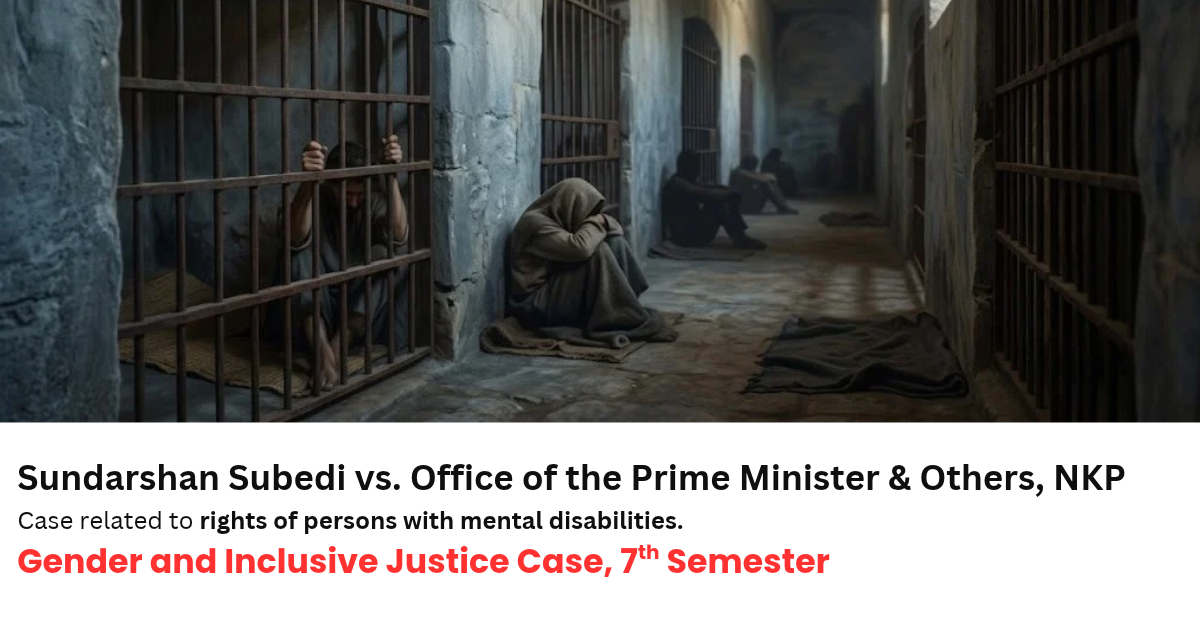
Gender and Inclusive Justice Case: Advocate Sundarshan Subedi vs. Office of the Prime Minister & Others, NKP, Writ No. 129, Date of Decision 2066, DN: 8053
Case: Voidance of Law inconsistent with constitution
Plaintiff: Advocate Sundarshan Subedi
Defendant: Office of the Prime Minister & Others
Decision Number: 8053
The case is relating to the rights of persons with mental disabilities and the use of prison for their detention and treatment.
Facts of the Case:
The Public Interest Protection Forum and Nepal Disabled Human Rights Centre filed a constitutional petition before the Supreme Court on behalf of persons with mental disabilities.
The petition challenged several laws, including Section 6 of the Muluki Ain, Section 9(7) of the Local Administration Act and Section 16(2) of the Disabled Protection and Welfare Act. These provisions allowed persons with mental illness to be detained in jails or prisons, sometimes until recovery.
The petitioners argued that people who had committed no crime were being imprisoned simply because of their mental condition. They were often kept without proper psychiatric treatment, rehabilitation or care facilities.
They claimed that such detention violated the constitutional rights to equality, liberty, dignity, health and social protection. They also relied on international human rights standards.
A letter from Kavrepalanchok prison revealed that 27 persons with mental illness were being detained there, showing that these laws were being used in practice.
Plaintiff’s Claims:
The petitioners argued that mental illness is a health condition, not a crime. They said that keeping mentally ill persons in prisons, fetters, or cages was inhuman and violated their rights to equality, dignity, personal liberty, health, and social protection. They asked the Court to invalidate the discriminatory provisions and direct the Government to provide proper mental-health treatment, rehabilitation, and care facilities.
Defendants’ Arguments:
The Government argued that the laws were intended to protect mentally ill persons and society. It stated that mentally ill prisoners could be separated from other prisoners and treated by government doctors according to available resources. It also argued that making or amending laws was mainly the responsibility of the legislature.
Legal Questions:
- Whether a person with mental illness could be detained in prison without having committed a crime?
- Whether keeping mentally ill persons in fetters, cages, or prisons violated their fundamental rights?
- Whether prison could be used as a place for psychiatric treatment?
- Whether the Government had a duty to provide proper mental-health treatment and rehabilitation?
Different Court Decisions:
Supreme Court Decision:
The Supreme Court held that mental illness is not a crime and that a person does not lose fundamental rights merely because of mental illness. It found that the disputed provisions could allow mentally ill persons to be detained in prison without a criminal conviction and without adequate medical safeguards.
The Court held that prison was not an appropriate place for psychiatric treatment. Keeping a person in prison instead of providing proper medical care was inconsistent with the person’s dignity and constitutional rights.
The Court declared the words “put in fetters and kept in a cage or prison” in Section 6 of the Muluki Ain invalid. It also invalidated the part of Section 16(2) of the Disabled Protection and Welfare Act that allowed such persons to be kept in prison for treatment or security. However, provisions concerning the treatment of prisoners lawfully detained for criminal offences remained valid.
The Court directed the Government to prepare proper laws and policies for the treatment, protection and rehabilitation of persons with mental illness. It also ordered an assessment of existing mental health facilities and directed that persons with mental illness already in prison be transferred to treatment centres or provided care by specialist doctors where such centres were unavailable.
Principles Established:
1. Mental illness is a health condition, not a crime, and cannot alone justify imprisonment.
2. Persons with mental disabilities do not lose their fundamental rights and are entitled to dignity, equality, liberty and health.
3. Prisons cannot be used as substitutes for psychiatric hospitals or proper treatment facilities.
4. The State has a duty to provide proper mental-health treatment, care and rehabilitation.
5. Any detention for treatment or security must follow legal and medical safeguards. Indefinite detention without such safeguards violates fundamental rights.