
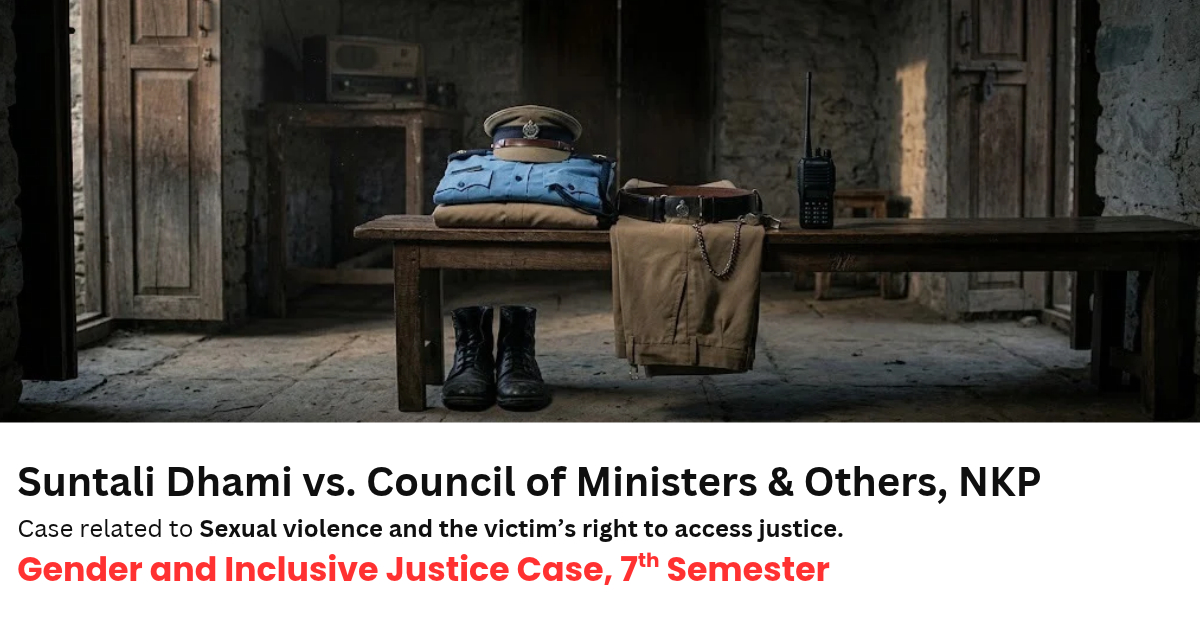
Gender Justice Case: Suntali Dhami vs. Council of Ministers & Others, NKP (2068), No. 1, P. 112, DN: 8541
Case: Mandamus
Plaintiff: Suntali Dhami
Defendant: Council of Ministers & Others
Decision Number: 8541
This case is relating to sexual violence, prosecutorial discretion, judicial review, and the victim’s right to access justice.
Facts of the Case:
Suntali Dhami (Shah) was a woman police officer working at the District Police Office in Achham. She was called to a communications bunker by her fellow police personnel.
According to her complaint, she was given meat after entering the bunker. Soon after eating it, she became dizzy and weak. She suspected that a drug had been mixed into the food. She alleged that the police personnel then restrained, assaulted, threatened, and sexually abused her. She alleged that six fellow police personnel raped her one after another.
Suntali later tried to file a complaint, but it was not properly accepted. An investigation was eventually conducted. Three of the accused were prosecuted, while Dan Singh Bhandari, Viradatta Badu, and Nariman Mahattara were not prosecuted.
Suntali challenged the decision, arguing that the same incident and evidence were relevant to all six accused. She also pointed to medical evidence showing a fresh bite mark on Nariman Mahattara’s thumb.
Plaintiff’s Claims:
Suntali claimed that the authorities had failed to properly investigate and prosecute all persons involved. She argued that refusing to prosecute three of the accused was unfair and unreasonable. She asked the Court to cancel the decision and order their prosecution. She also argued that the prosecutor’s decision could not be beyond judicial review when it affected her right to access justice.
Defendants’ Arguments:
The police and government authorities argued that the Attorney General and government prosecutors had the authority to decide whether to prosecute a criminal case. They argued that the prosecutor had examined the evidence and found insufficient grounds to prosecute the three accused.
They also argued that the limitation period for filing a rape case had expired. Therefore, they claimed that the Court could not order a fresh prosecution and asked the Court to dismiss the petition.
Legal Questions:
- Whether the decision not to prosecute could be reviewed by the Supreme Court?
- Whether Suntali’s right to access justice was violated by the decision not to prosecute three accused?
- Whether the available evidence was sufficient to require their prosecution?
- Whether the limitation period prevented the Court from ordering prosecution?
Different Court Decisions:
Police and Government Prosecutor’s Decision:
The authorities prosecuted three accused but decided not to prosecute Dan Singh Bhandari, Viradatta Badu, and Nariman Mahattara. They relied on insufficient evidence and the prosecutor’s authority to decide whether to prosecute.
Supreme Court:
The Supreme Court held that the Attorney General’s decision not to prosecute is subject to judicial review. Prosecutorial discretion does not place such decisions beyond the Court’s review. The Court also emphasised that access to justice is a fundamental right. This is especially important because victims depend on the State to investigate and prosecute crimes.
The Court found that Suntali had complained against all six persons. The available evidence, including a fresh bite mark on Nariman Mahattara’s thumb, also supported prosecution of the three persons who were not charged.
The Court quashed the decision not to prosecute Dan Singh Bhandari, Viradatta Badu and Nariman Mahattara. It directed the District Government Attorney’s Office, Achham, to file charges against them under the relevant rape law.
The Court clarified that ordering prosecution did not establish the accused persons’ guilt. Their guilt must be decided by the trial court. It also held that the limitation objection did not prevent prosecution.
Principles Established:
1. The Attorney General’s decision not to prosecute is subject to judicial review.
2. Access to justice is a fundamental right, and victims should not be denied justice due to improper prosecutorial decisions.
3. Prosecutorial independence does not protect arbitrary or unreasonable decisions.
4. The State must conduct criminal investigations and prosecutions fairly and independently.
5. Courts may order prosecution when sufficient evidence exists and the refusal to prosecute violates the victim’s rights.|
6. Ordering prosecution does not establish guilt. The trial court must independently decide whether the accused is guilty or innocent.