

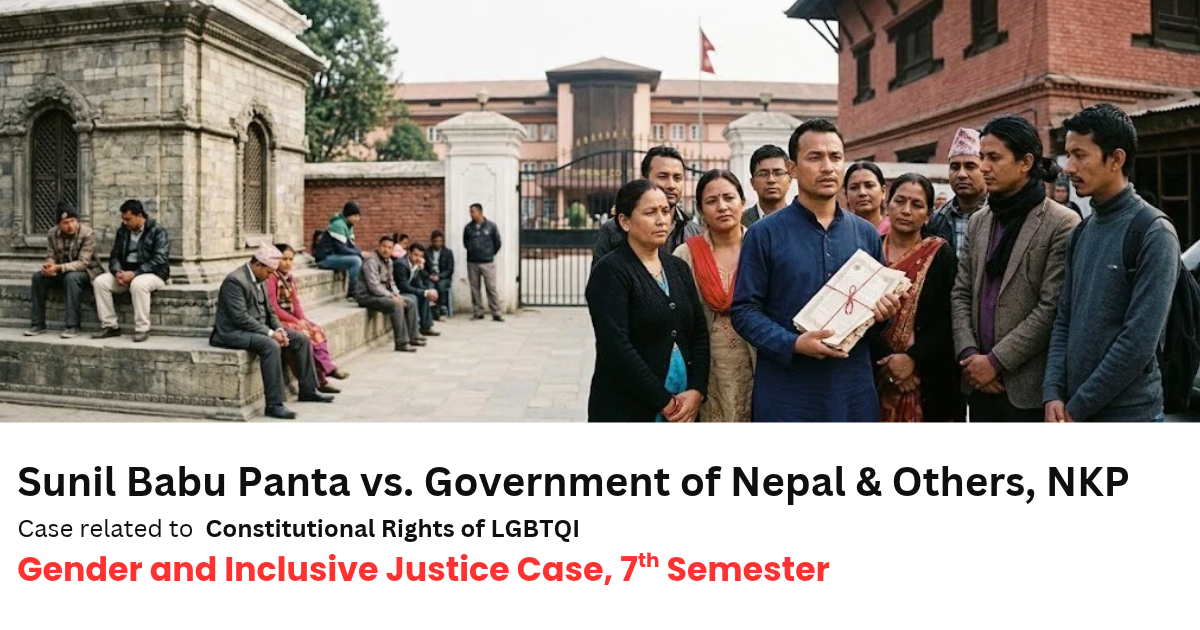
Gender and Inclusive Justice Case: Sunil Babu Panta vs. Government of Nepal & Others, NKP (2064), No.4, DN: 7958
Case: Certiorari, Mandamus and others
Plaintiff: Sunil Babu Panta
Defendant: Government of Nepal & Others
Decision Number: 7958
The case is relating to the constitutional rights of LGBTQI people, including equality, gender identity, privacy, dignity, and protection from discrimination.
Facts:
Sunil Babu Pant, Executive Director of Blue Diamond Society, filed a public interest writ petition against the Government of Nepal on behalf of LGBTQI+ people.
The petition highlighted widespread discrimination, social exclusion, violence and harassment faced by these communities. They also faced difficulties in obtaining citizenship, passports and voter documents, as well as accessing education, employment and public services.
People whose gender identity did not fit traditional male or female categories faced additional problems, as official documents often failed to recognise their identity. The petition also challenged the lack of legal recognition and protection for same-sex relationships between consenting adults.
The petitioners argued that these practices violated the fundamental rights to equality, dignity, liberty and privacy under the Interim Constitution of Nepal, 2007. They also relied on Nepal’s international obligations under the ICCPR and ICESCR.
Plaintiff’s Claims:
The petitioners argued that LGBTQI+ people were entitled to equal constitutional rights and protection from discrimination.
They sought recognition of a third gender category, identity documents based on self identified gender, protection from violence, and a study of the legal recognition of same sex marriage.
Defendants’ Arguments:
The Government and Parliament argued that constitutional rights were already available to all citizens. They said that the petitioners could obtain citizenship and other documents under the existing law.
They also argued that the petition did not clearly identify a specific discriminatory law or government action. They maintained that creating or changing laws was mainly the responsibility of Parliament. They therefore asked the Court to dismiss the petition.
Legal Questions:
- Whether LGBTI people are entitled to the same constitutional rights as other citizens?
- Whether denying or restricting identity documents based on gender identity violates equality and identity rights?
- Whether consensual sexual relationships between adults are protected by privacy and personal liberty?
- Whether the State has a duty to create or amend laws to protect LGBTI people from discrimination?
Different Court Decisions:
Supreme Court:
The Supreme Court held that the petition was a genuine public-interest case, as LGBTQI people faced social marginalisation and difficulties in protecting their rights individually.
The Court recognised that people of different sexual orientations and gender identities are entitled to equal fundamental rights and must not face discrimination on these grounds.
It upheld the right to privacy in consensual relationships between adults, holding that the State cannot interfere merely because the partners are of the same sex.
The Court directed the State to make appropriate arrangements for people whose gender identity does not fit within the traditional male and female categories.
It ordered the Government to introduce or amend laws and administrative arrangements to ensure equal rights and protection for LGBTQI people.
The Court also directed the formation of a committee to study the legal and social aspects of same-sex marriage and recommend possible legal recognition.
Principles Established:
1. LGBTIQ people are entitled to equal fundamental rights and protection against discrimination based on sexual orientation or gender identity.
2. Every person has the right to gender identity and appropriate official documents.
3. Privacy and personal liberty protect consensual intimate relationships between adults, regardless of sexual orientation.
4. Social prejudice, tradition or culture cannot justify denying fundamental rights.
5. The State must introduce necessary legal and administrative reforms to ensure equal rights and protection.
6. Public interest litigation can safeguard the rights of socially marginalized groups.